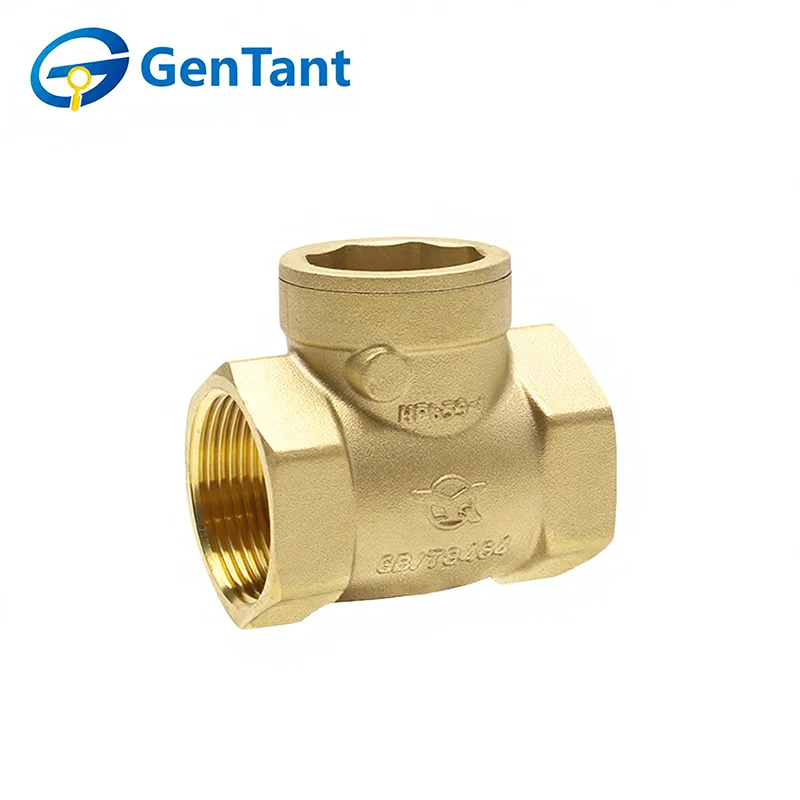
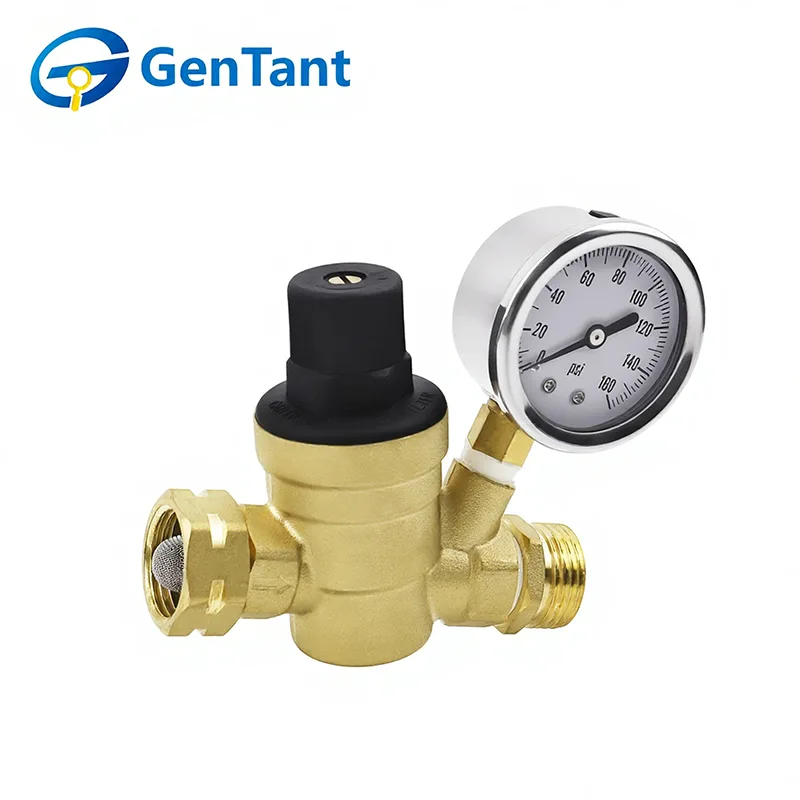
Pressure Reducing Valve With Gauge
Shop customized versions of the Pressure Reducing Valve With Gauge from GenTant, a professional manufacturer and supplier in China. With extensive experience in the field, we focus intently on understanding and fulfilling our customer's specific requirements. Our team of professional engineers and skilled staff leverages deep technical expertise to deliver tailored solutions for diverse residential and commercial applications. We ensure every valve, from standard to fully customized designs, meets rigorous standards of accuracy, durability, and reliability, providing a complete and user-friendly solution for optimal system performance and safety.
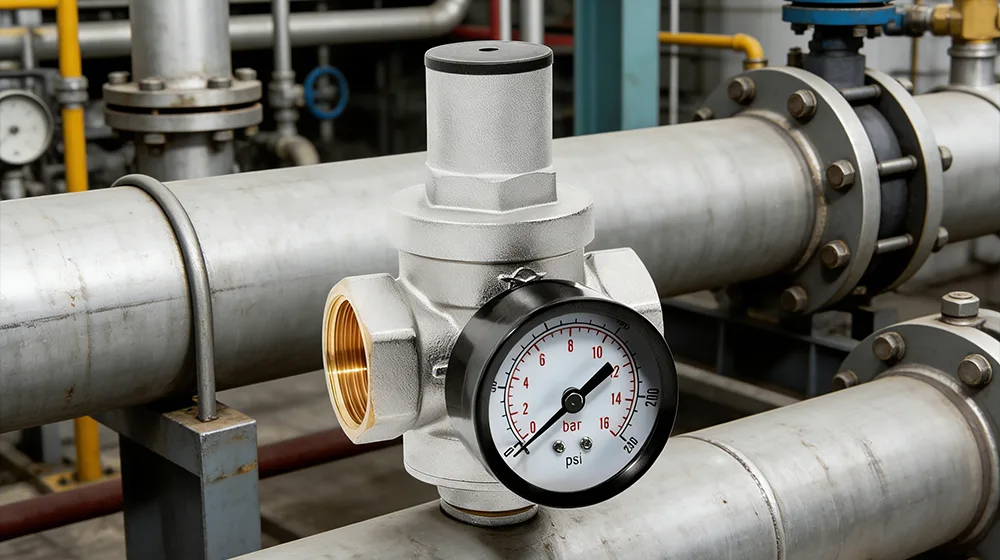
Pressure Reducing Valve With Gauge is integrated control assemblies designed to ensure precise pressure management within fluid systems. The valve's core function is to automatically reduce a higher, fluctuating inlet pressure to a stable, safe, and predefined outlet level, thereby protecting downstream pipelines, equipment, and appliances from damage. The integrated pressure gauge provides immediate, at-a-glance visual verification of the set outlet pressure, facilitating effortless monitoring, initial setup, and ongoing system diagnostics.
Product Feature and Application
This static and dynamic Pressure Reducing Valve With Gauge maintains stable downstream pressure regardless of large inlet fluctuations. Featuring a robust PN16-rated construction, it allows both horizontal and vertical installation without affecting performance, adjustment, or sealing. Compliant with European EN1567 standards, its regulating spring is completely isolated from drinking water to ensure hygiene and safety.
Primarily used in municipal water supply systems with high or unstable pipeline pressures, the valve effectively reduces and stabilizes inlet water pressure for end users. Its key function is to automatically maintain constant downstream pressure despite upstream variations while meeting flow demand, ensuring reliable and safe residential water supply.
Product Parameter (Specification)
Threaded connection type
DN15 (1/2")、DN20 (3/4")、DN25 (1")、DN32 (1-1/4")、DN40 (1-1/2")、DN50 (2")
Technical Specification
Maximum Allowable Working Pressure (PN): 16 bar
Pressure Regulating Range (Ps): 1~6 bar
Outlet Pressure Factory Setting: 3 bar
Outlet Pressure Variation Range: ±10%
Working Temperature Range: 0℃(non-freezing) ~ (80℃
Noise Level (dB(A)): 30 dBA
Material Composition
① Valve Body, Valve Cover, Valve Spool: HPb59-1
② Sealing Element: EPDM
Product Dimension
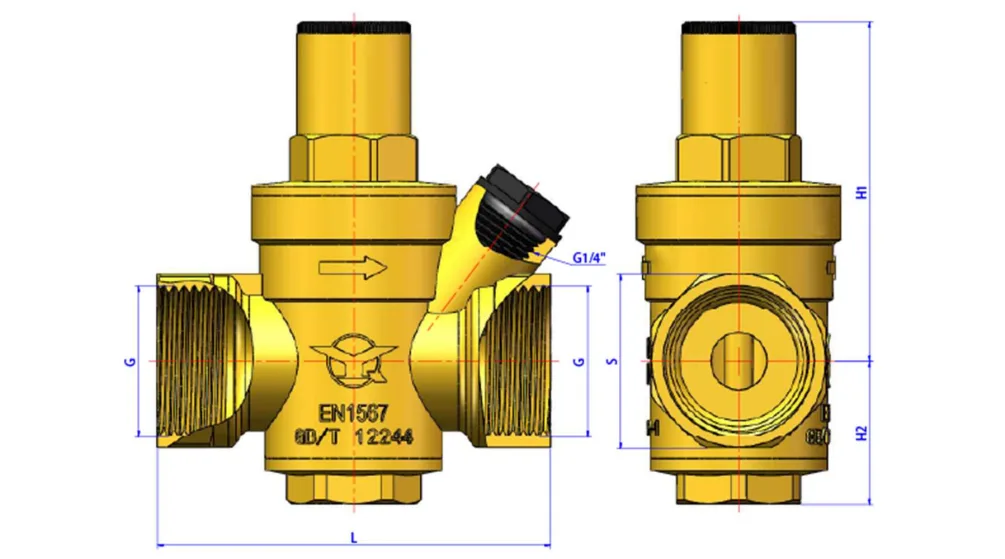
|
DN(mm) |
G |
L(mm) |
S(mm) |
H1(mm) |
H2(mm) |
|
15 |
1/2" |
66 |
25 |
55.5 |
25.5 |
|
20 |
3/4" |
70 |
31 |
55.5 |
25.5 |
|
25 |
1" |
86 |
38 |
75 |
33 |
|
32 |
1-1/4" |
90 |
47 |
75 |
33 |
|
40 |
1-1/2" |
102 |
53 |
98 |
51 |
|
50 |
2" |
108 |
65 |
98 |
51 |
Product Structure and Working Principle
Working Principle
The core function of Pressure Reducing Valve With Gauge is the precise modulation of high inlet pressures to a stabilized, calibrated outlet pressure, thereby safeguarding the integrity of subsequent domestic and industrial fluid systems against surge events or localized overpressure conditions.
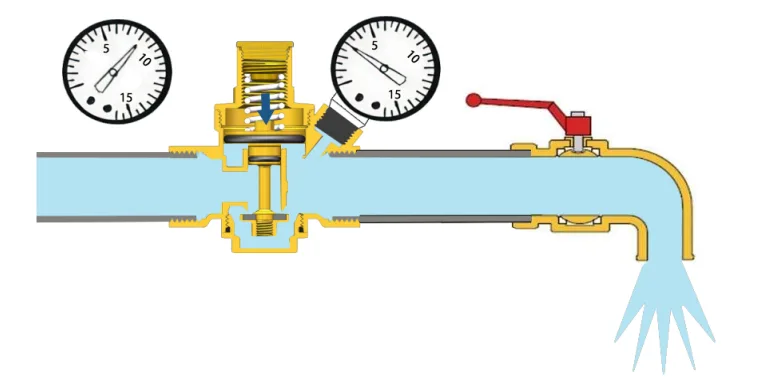
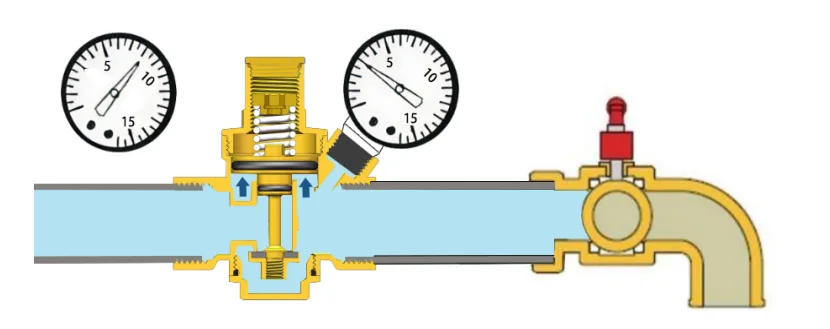
Mechanistically, the device establishes a hydraulic equilibrium by balancing two primary forces: the static force exerted by a pre-tensioned spring, which biases the valve toward an open position, against the dynamic closing force generated by the upstream fluid pressure acting upon the internal piston. This continuous, self-actuating balance effectively maintains a consistent, reduced pressure state downstream, optimizing both fluid delivery and system protection.
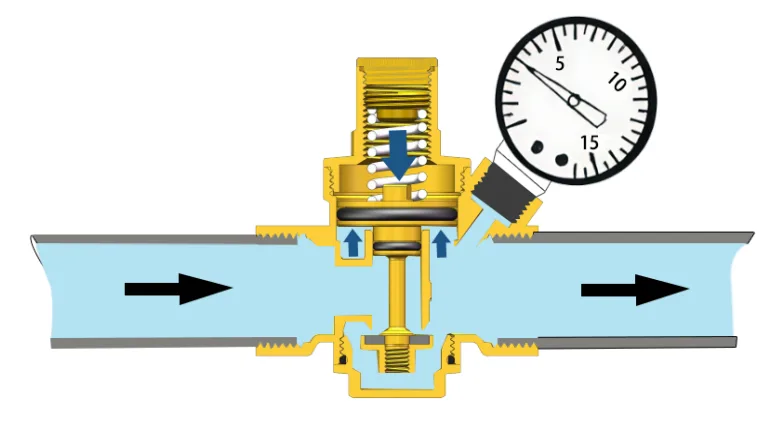
Operating Status During Water Consumption
When the water faucet is opened, the force exerted by the internal spring surpasses the upward hydraulic pressure acting upon the lower surface of the piston. Consequently, the piston translates downwards, thereby opening the fluid flow passage. As additional downstream faucets are activated, the counter-pressure beneath the piston diminishes, resulting in a proportional increase in the volumetric flow rate through the pressure reducing valve.
Operating Status During Zero Flow
Upon the closure of a downstream faucet, the hydraulic pressure within the downstream circuit elevates. This increased pressure drives the internal piston upward, effectively sealing the fluid passage and stabilizing the downstream pressure at its predefined set point. The instantaneous closure of the pressure reducing valve is achieved when the upward hydraulic force acting on the piston exceeds the counteracting force exerted by the internal spring mechanism.
Installation and operation instructions
4.1 Prior to installing the Pressure Reducing Valve With Gauge, it is recommended to purge air and dirt from the piping system.
4.2 Verify the direction of water flow (indicated by an arrow on the valve body).
4.3 The pressure reducing valve can be installed on both vertical and horizontal pipe sections (inverted installation is prohibited).
4.4 The valve must not be installed in locations where freezing may occur, such as outdoors, as freezing will damage the unit.
4.5 The pressure reducing valve should be installed in an easily accessible location for pressure adjustment and reading. Installation within pipe shafts is not recommended due to potential freezing.
4.6 The "water hammer" phenomenon is a primary cause of pressure reducing valve failure. Installation methods as illustrated in the figure below are recommended, as they optimize operation for all downstream equipment and facilitate easier maintenance tasks.
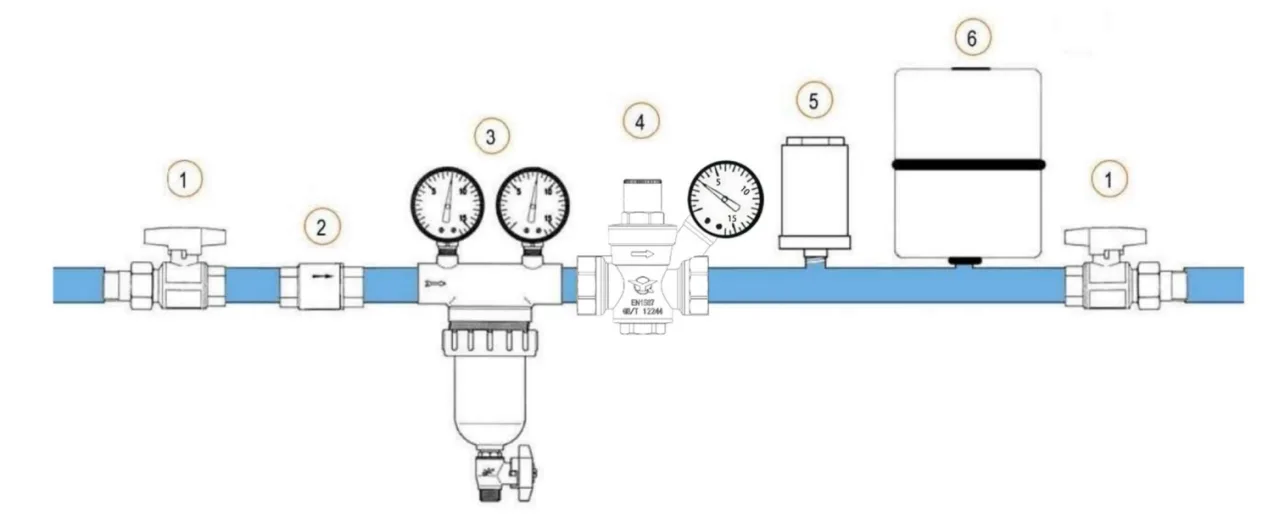
① Shut-off valve: Installed upstream and downstream of the pressure reducing valve to facilitate maintenance operations for various equipment.
② Check valve: Prevents backflow.
③ Filter: Filters impurities in the main supply pipe to prevent fouling in all downstream equipment and maintain their performance.
④ Piston-type dynamic stable pressure reducing valve.
⑤ Water hammer arrestor: Prevents pipeline fluctuations when the water supply is restored after an interruption, which could damage all downstream equipment.
⑥ Expansion vessel: Used in hot water and hot water storage systems where pressure may rise due to fluid heat, acting to absorb overpressure.
pressure regulation
The outlet pressure of the Pressure Reducing Valve With Gauge is factory-preset to 3 bar; the downstream pressure can be adjusted using the following methods:
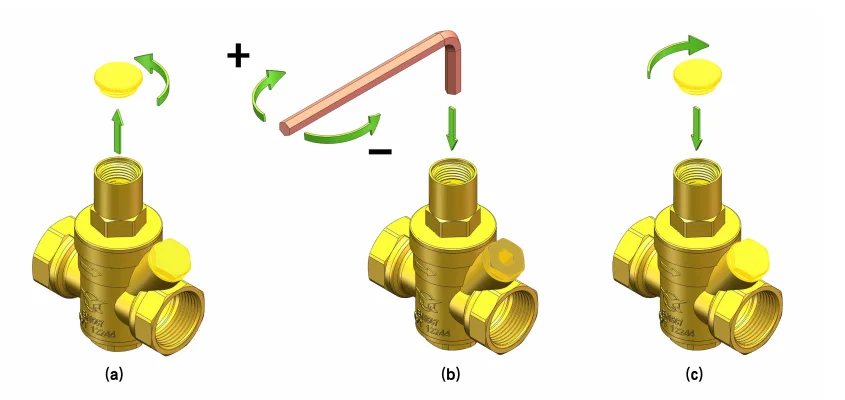
1.Close the shut-off valve behind the pressure reducing valve
2.Unscrew the plastic cap counterclockwise
3.Insert an Allen key into the pressure reducing valve adjusting cap to adjust: turn clockwise to increase downstream pressure, turn counterclockwise to decrease downstream pressure (Figure b)
4.The pressure value displayed on the pressure gauge of the pressure reducing valve is the adjusted downstream pressure
5.After adjustment is complete, tighten the plastic cap clockwise
To avoid the occurrence of noise or cavitation phenomena, it is recommended to maintain an inlet-to-outlet pressure reduction ratio below 2.5. For instance, if the required outlet pressure is 4 bar, the inlet pressure should not exceed 10 bar. If needed, consider installing additional pressure reducing valves in series to achieve the desired pressure reduction in stages.
Trouble Shooting
① Pressure Reducing Valve With Gauges installed in hot water pipelines or hot water storage systems will experience an increase in downstream pressure. This occurs because heating the water increases the pressure, and when there is no water consumption, the pressure reducing valve is in a closed state, preventing the accumulated pressure from being "released."
Solution: Install an expansion vessel between the hot water inlet and the pressure reducing valve to absorb the increased pressure.
② Inconsistent downstream pressure with the set pressure value. In areas with poor water quality, impurities flowing through the pressure reducing valve can easily accumulate between the valve seat and the piston, preventing the valve from closing completely. This allows upstream pressure to seep into the downstream side, thus raising the downstream pressure.
Solution: Install a filter upstream of the pressure reducing valve and perform regular cleaning.
Send Inquiry
Contact Info
-
Address
Dieyuan Road, YinZhou District, Ningbo, Zhejiang, China
-
Tel
-
Email
If you have any enquiry about quotation or cooperation, please feel free to email us at zchen@gentantvalves.com or use the following inquiry form. Our sales representative will contact you within 24 hours. Thank you for your interest in our products.
News Recommendations